Faith and Science
15 December 2025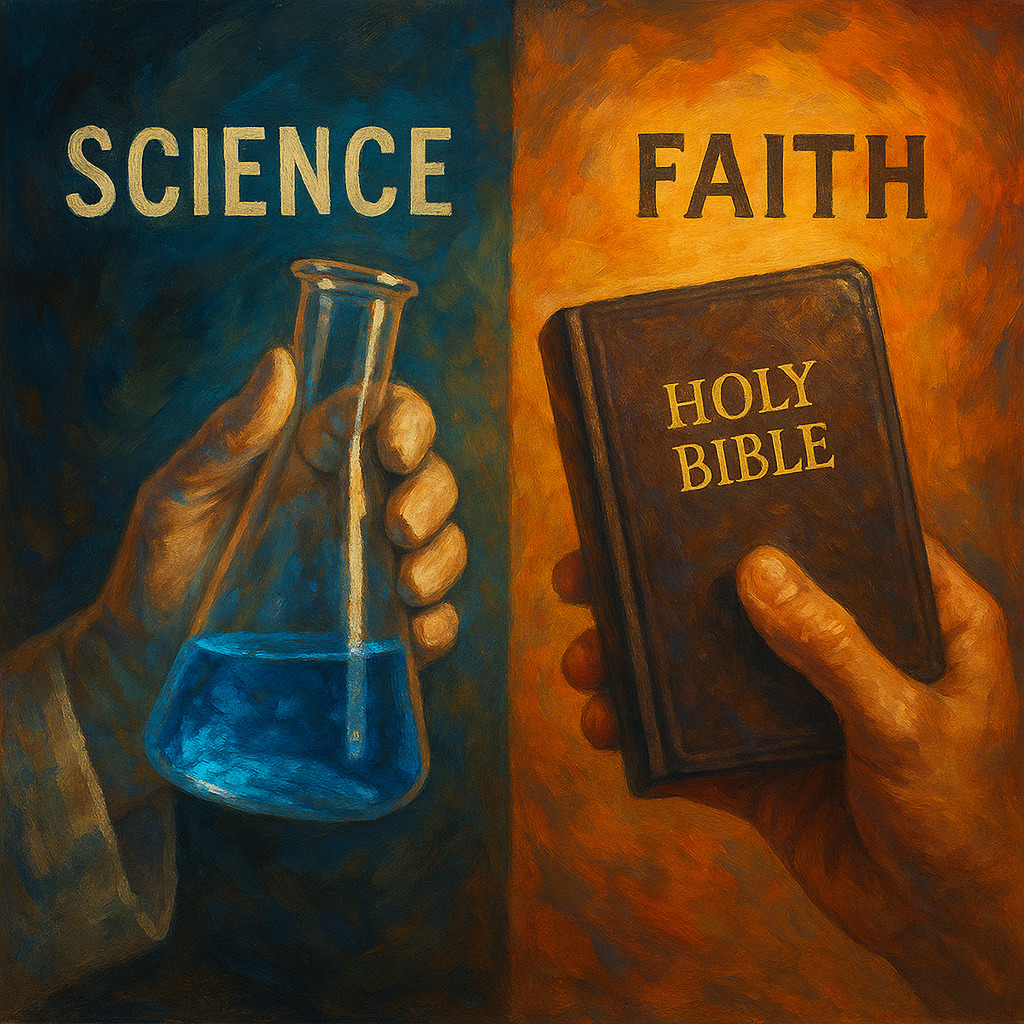
The perceived tension between faith and science has captivated thinkers across centuries, often evoking images of conflict, contradiction, or uneasy coexistence. Yet much of this presumed antagonism stems not from any inherent opposition, but rather from a misunderstanding of their respective domains, methodologies, and aims. To explore their relationship more deeply, it is crucial to begin by clarifying what is meant by the terms “faith” and “science.”
Faith is frequently considered as blind allegiance to unprovable claims, standing in contrast to reason and evidence. Merriam-Webster defines faith as “firm belief in something for which there is no proof” [1], a definition that can be misconstrued to imply irrationality or emotionalism. However, the Oxford English Dictionary offers a more refined interpretation: “strong belief in the doctrines of a religion, based on spiritual conviction rather than proof” [2]. This view allows room for experiential knowledge, spiritual insight, and reasoned trust.
The biblical tradition, especially in Hebrews 11:1, portrays faith as “the substance of things hoped for, the evidence of things not seen” [3]. Here, faith is not a leap into the dark but a step into the light based on trust, relational knowledge, and testimony. Philosopher Alvin Plantinga supports this by asserting that faith can be a rationally warranted belief, grounded in its own epistemic framework and not reducible to empirical validation [4]. Faith, then, is not the enemy of reason, but a parallel form of knowing that addresses dimensions of life inaccessible to empirical scrutiny.
Science, by contrast, is the disciplined pursuit of knowledge about the natural world through observation, experimentation, and critical analysis. Its strength lies in its empirical methodology, which is governed by principles such as falsifiability, testability, and reproducibility [5]. Science seeks to answer questions of “how” – how natural phenomena occur, how systems behave, and how various elements of the physical universe interrelate. However, it deliberately refrains from addressing questions of ultimate meaning, ethical value, or spiritual purpose [6].
Therefore, faith and science occupy complementary domains: science explains the mechanics of the natural world, while faith contemplates meaning, value, and ultimate reality [7]. Far from being adversaries, they are distinct yet potentially harmonious pathways toward understanding the fullness of human existence.
The story of science and religion is far richer and more complex than the popular “conflict narrative” suggests. While some moments in history reflect tension, others reveal profound collaboration. Indeed, many of the pioneers of scientific thought were motivated by religious belief and sought to explore the natural world as a means of glorifying its Creator. For instance, Isaac Newton – whose laws of motion and gravitation laid the foundation for classical physics – saw his work as uncovering the rational order God had woven into creation [8]. In the Islamic Golden Age, figures like Alhazen and Avicenna exemplified a deep commitment to both rigorous scientific inquiry and theological reflection [9]. In medieval Christian Europe, Thomas Aquinas made a seminal contribution by integrating Aristotelian logic with Christian doctrine, arguing that reason and revelation ultimately lead to the same truth [10].
The rise of the so-called “conflict thesis” in the 19th century, advanced by John William Draper and Andrew Dickson White, painted religion as a suppressive force and science as its enlightened opponent [11]. Yet modern historians of science widely critique this narrative as overly simplistic and historically inaccurate. Scholars like Peter Harrison and John Hedley Brooke have revealed a more nuanced picture, characterized by moments of collaboration, co-development, and respectful independence [12].
The Galileo affair is frequently cited as emblematic of science-religion antagonism, but the reality is more intricate. Galileo, a faithful Catholic, initially received support from church officials [13]. The eventual conflict was as much about ecclesiastical politics and interpretive authority as it was about scientific evidence. At the time, the heliocentric model lacked definitive proof, and the Church’s caution reflected a desire to uphold traditional cosmology rather than to suppress truth [14].
Modern science has unveiled stunning insights into the origins and development of the cosmos, reshaping humanity’s understanding of its place in the universe. The Big Bang theory – currently the most widely accepted model for the origin of the universe – posits that all space, time, and matter originated approximately 13.8 billion years ago from an initial singularity [15]. This notion of a cosmic beginning aligns strikingly with the theological concept of creatio ex nihilo, the belief that God created the universe out of nothing [16].
Notably, Georges Lemaître, a Catholic priest and physicist, was the first to propose what he called the “primeval atom,” which later evolved into the Big Bang theory [17]. Lemaître himself cautioned against conflating scientific theories with theological doctrines, emphasizing that science speaks to physical processes, not divine purposes [18] In biology, Charles Darwin’s theory of evolution by natural selection revolutionized our understanding of life’s diversity [19]. While evolution has been met with opposition from some religious literalists, it has also been embraced by many theologians and scientists who interpret it as the method through which God brings about life’s complexity [20]. Theistic evolution, endorsed by thinkers like Francis Collins, reconciles evolutionary science with a belief in divine intentionality [21]. Collins, who led the Human Genome Project, sees in the language of DNA a reflection of divine intelligence and order [22].
Thus, rather than undermining faith, the discoveries of cosmology and evolutionary biology can inspire awe and deeper theological reflection.
While science excels in exploring the physical universe, it is not equipped to answer all questions, especially those concerning ultimate purpose, ethical values, or existential meaning. Questions such as “Why is there something rather than nothing?” or “What is the foundation of moral obligation?” transcend empirical analysis [23]. These are not merely gaps in scientific knowledge but fundamentally different types of inquiries.
Immanuel Kant famously argued that while reason is powerful, it is limited in its ability to access metaphysical truths [24]. Concepts such as God, freedom, and immortality, according to Kant, lie beyond the scope of pure reason yet remain essential for coherent moral and existential frameworks. Blaise Pascal, in his Pensées, affirmed that the heart has its reasons, which reason does not know [25]. Faith, in this view, engages a dimension of human experience that logic alone cannot penetrate.
Even modern physics confronts mysteries that challenge reductionist explanations. The indeterminacy of quantum mechanics, the role of the observer, and the universe’s fine-tuning all raise profound questions about the nature of reality [26]. The precise calibration of physical constants necessary for life to exist has led some to speculate about a multiverse, while others see evidence of intelligent design [27]. John Polkinghorne, a physicist and theologian, argues that such mysteries invite metaphysical reflection rather than premature conclusions [28].
A growing number of contemporary scholars advocate for a symbiotic relationship between faith and science. Francis Collins, in The Language of God, describes how his scientific journey has deepened his Christian belief rather than undermined it [29]. Alister McGrath, with doctorates in both molecular biophysics and theology, proposes a model of “critical realism” that recognizes the partial, progressive nature of both scientific and theological understanding [30].
John Polkinghorne exemplifies this integrative approach. As both a physicist and Anglican priest, he contends that science and theology are complementary – not because they say the same things, but because they ask different questions about the same reality [31]. Science explores mechanisms and patterns; theology probes meaning and origin [32].
These voices represent a growing consensus that the deepest truths are not found in isolation, but at the intersection of diverse disciplines, where reason and revelation enrich each other.
In a fragmented age where intellectual life is often divided into competing domains, it is tempting to relegate science to the laboratory and faith to private devotion. Yet such compartmentalization distorts both. Human beings are not merely rational machines nor purely spiritual beings – we are integrated wholes, drawn to truth, meaning, and beauty through multiple ways of knowing. Faith and science offer complementary perspectives on reality. Where science unravels the how of the universe, faith contemplates the why. Where science charts the laws of nature, faith considers the source of those laws. These are not rival pursuits but parallel paths in the human quest for understanding. To integrate faith and science is not to dilute either but to allow each to inform and challenge the other. This integration requires intellectual humility, moral courage, and an openness to mystery. Though the journey is complex, it is deeply rewarding – for in reconciling these realms, we move closer to a holistic understanding of the cosmos and our place within it [33].
- Merriam-Webster. Faith. Retrieved from https://www.merriam-webster.com/dictionary/faith
- Oxford English Dictionary. Faith. Retrieved from https://www.oed.com
- The Holy Bible, New International Version. (1978). Hebrews 11:1.
- Plantinga, A. (2000). Warranted Christian Belief. Oxford University Press.
- Popper, K. (2002). The Logic of Scientific Discovery. Routledge.
- Gould, S. J. (1997). Nonoverlapping Magisteria. Natural History, 106(2), 16–22.
- McGrath, A. (2016). Inventing the Universe: Why We Can’t Stop Talking About Science, Faith and God. Hodder & Stoughton.
- Newton, I. (1958). The Principia: Mathematical Principles of Natural Philosophy (Trans. A. Motte). University of California Press.
- Nasr, S. H. (2006). Science and Civilization in Islam. Harvard University Press.
- Aquinas, T. (1265–1274). Summa Theologica.
- White, A. D. (1896). A History of the Warfare of Science with Theology in Christendom. D. Appleton.
- Harrison, P. (2015). The Territories of Science and Religion. University of Chicago Press.
- Finocchiaro, M. A. (1989). The Galileo Affair: A Documentary History. University of California Press.
- Coyne, G. (2005). Wayfarers in the Cosmos: The Human Quest for Meaning. Crossroad Publishing.
- Hawking, S., & Mlodinow, L. (2010). The Grand Design. Bantam Books.
- Craig, W. L., & Sinclair, J. (2009). The Kalam Cosmological Argument. In The Blackwell Companion to Natural Theology (pp. 183–252). Wiley-Blackwell.
- Kragh, H. (2013). The Cosmological Ideas of Georges Lemaître. In D. S. Oderberg (Ed.), Classical Theism (pp. 311–332). Routledge.
- Lemaître, G. (1931). The Beginning of the World from the Point of View of Quantum Theory. Nature, 127, 706.
- Darwin, C. (1859). On the Origin of Species. John Murray.
- Miller, K. R. (2007). Finding Darwin’s God: A Scientist’s Search for Common Ground Between God and Evolution. Harper Perennial.
- Collins, F. S. (2006). The Language of God: A Scientist Presents Evidence for Belief. Free Press.
- Collins, F. S. (2010). The Language of Life: DNA and the Revolution in Personalized Medicine. Harper.
- Nagel, T. (2012). Mind and Cosmos: Why the Materialist Neo-Darwinian Conception of Nature is Almost Certainly False. Oxford University Press.
- Kant, I. (1781). Critique of Pure Reason.
- Pascal, B. (1669). Pensées.
- Davies, P. (2007). The Goldilocks Enigma: Why Is the Universe Just Right for Life? Houghton Mifflin.
- Barrow, J. D., & Tipler, F. J. (1986). The Anthropic Cosmological Principle. Oxford University Press.
- Polkinghorne, J. (2005). Science and Theology: An Introduction. SPCK.
- Collins, F. S. (2006). The Language of God. Free Press.
- McGrath, A. E. (2011). Surprised by Meaning: Science, Faith, and How We Make Sense of Things. Westminster John Knox Press.
- Polkinghorne, J. (1994). Science and Christian Belief. SPCK.
- Haught, J. F. (2010). Making Sense of Evolution: Darwin, God, and the Drama of Life. Westminster John Knox Press.
- Turek, F., & Geisler, N. L. (2004). I Don’t Have Enough Faith to Be an Atheist. Crossway.